Berkelium
Berkélium · Bk · 97
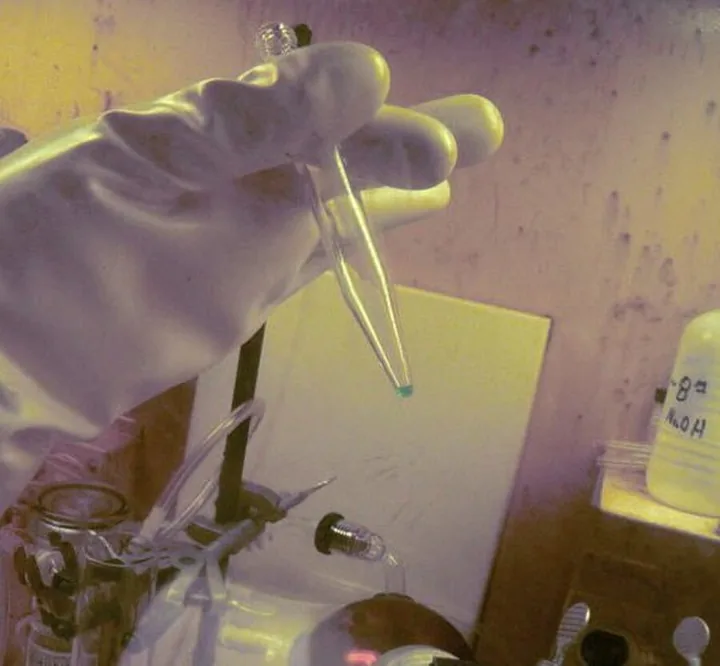
A radioactive metal made in 1949 and named after the city of Berkeley, California. Produced drop by drop, it served as a target to create element 117.
1Identity card
- Atomic number
- 97protons in the nucleus
- Symbol
- Bk
- Atomic weight
- [247]mass number of the most stable known isotope
- Family
- Actinides
- Group · period · block
- — (actinides) · 7 · f
- State at 20 °C
- solid
- Melting point
- 986 °C
- Boiling point
- 2,627 °C estimated value
- Density
- 14.78 g/cm³at 20 °C
- Electronegativity
- 1.3Pauling scale
- Electron configuration
- [Rn] 5f9 7s2
- Electrons per shell
- 2 · 8 · 18 · 32 · 27 · 8 · 2
- Discovery
- 1949Stanley G. Thompson, Albert Ghiorso, Glenn T. Seaborg
- Place
- Berkeley (United States)
2The berkelium atom
An atom of berkelium has 97 protons in its nucleus and, when neutral, as many electrons, spread over 7 shells.
3Discovery
In December 1949, at Berkeley, Stanley Thompson, Albert Ghiorso and Glenn Seaborg bombarded americium-241 with alpha particles and identified element 97, after months of trials in chemical separation.
Want to know more about Seaborg and other scientists? Visit Les inventeurs, a sister site devoted to scientists and their inventions (in French).
4Origin of the name
From the city of Berkeley in California, home of the university and laboratory where it was created, by analogy with terbium, named after the village of Ytterby.
5Where is it found?
It does not exist in nature; only a few milligrams a year are produced in research reactors with very high neutron flux.
6Uses
- Research only, notably as a target for making superheavy elements.
7Did you know?
In 2009 the Oak Ridge reactor in the United States produced 22 milligrams of berkelium-249, sent to Dubna in Russia to create element 117, tennessine. Speed was essential: half the berkelium disappears in less than a year.
Safety: Radioactive.
8Isotopes
No stable isotope. The longest-lived, berkelium-247, has a half-life of about 1,400 years; berkelium-249 (330 days) is the one most produced.
9Its neighbours in the table
Elements in the same column often have similar chemistry; those in the same row have the same number of electron shells.