Dysprosium
Dysprosium · Dy · 66
A silvery lanthanide, highly magnetic at low temperature. Added to neodymium magnets, it keeps them strong even when they heat up, as in electric-car motors.
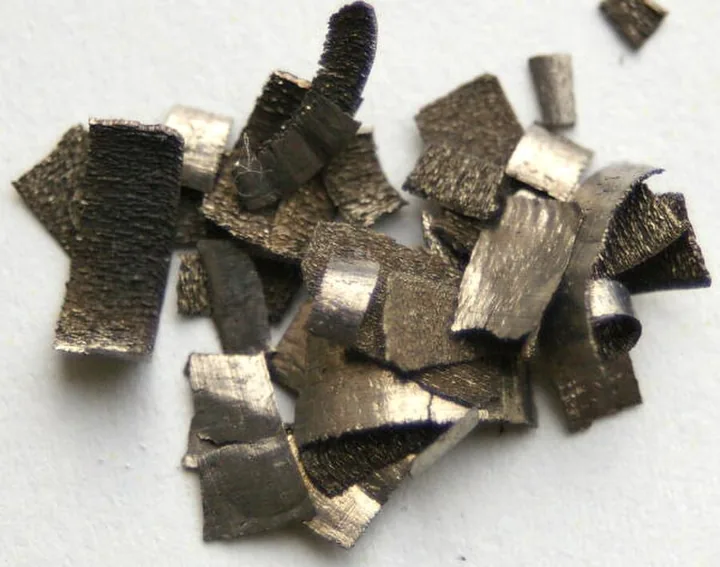
1Identity card
- Atomic number
- 66protons in the nucleus
- Symbol
- Dy
- Atomic weight
- 162.5 uIUPAC standard value
- Family
- Lanthanides
- Group · period · block
- — (lanthanides) · 6 · f
- State at 20 °C
- solid
- Melting point
- 1,412 °C
- Boiling point
- 2,567 °C
- Density
- 8.55 g/cm³at 20 °C
- Electronegativity
- 1.22Pauling scale
- Electron configuration
- [Xe] 4f10 6s2
- Electrons per shell
- 2 · 8 · 18 · 28 · 8 · 2
- Earth’s crust
- 5.2 g per tonne
- Discovery
- 1886Paul-Émile Lecoq de Boisbaudran
- Place
- Paris (France)
2The dysprosium atom
An atom of dysprosium has 66 protons in its nucleus and, when neutral, as many electrons, spread over 6 shells.
3Discovery
In 1886, in Paris, Paul-Émile Lecoq de Boisbaudran managed to separate dysprosium oxide from holmia after more than thirty successive precipitations on his laboratory bench. The pure metal was not obtained until 1950.
4Origin of the name
From the Greek dysprositos, “hard to get at”, a reminder of the patience needed to isolate it.
5Where is it found?
It is extracted mainly from the ionic clays of southern China, from monazite and from xenotime.
6Uses
- Neodymium magnets in electric-car motors and wind turbines.
- The Terfenol-D alloy, with terbium and iron.
- Reactor control rods and radiation dosimeters.
7Did you know?
Demand soared with the rise of electric cars, making dysprosium one of the metals the European Union considers most “critical”.
8Isotopes
Seven natural isotopes; dysprosium-164 is the most abundant (about 28%).
Isotopes found in nature and their abundance (CIAAW data)
9Its neighbours in the table
Elements in the same column often have similar chemistry; those in the same row have the same number of electron shells.