Einsteinium
Einsteinium · Es · 99
A radioactive element discovered in 1952 in the debris of a nuclear test in the Pacific. It is named after Albert Einstein; no more than a few thousandths of a gram have ever been produced.
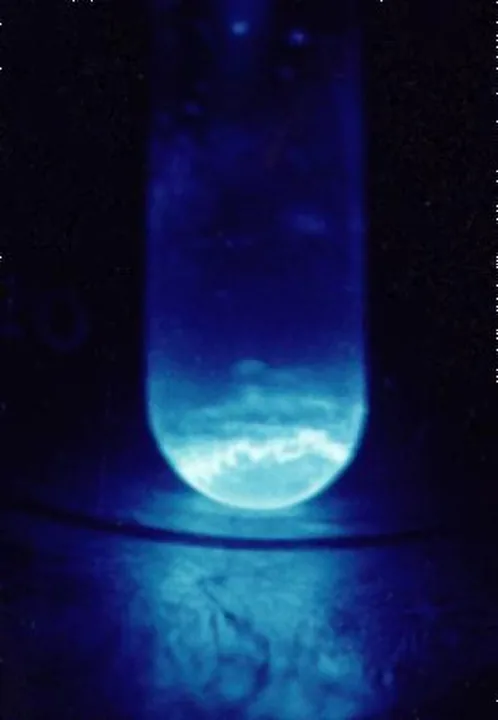
1Identity card
- Atomic number
- 99protons in the nucleus
- Symbol
- Es
- Atomic weight
- [252]mass number of the most stable known isotope
- Family
- Actinides
- Group · period · block
- — (actinides) · 7 · f
- State at 20 °C
- solid
- Melting point
- 860 °C
- Boiling point
- 996 °C estimated value
- Density
- 8.84 g/cm³ estimated value
- Electronegativity
- 1.3Pauling scale
- Electron configuration
- [Rn] 5f11 7s2
- Electrons per shell
- 2 · 8 · 18 · 32 · 29 · 8 · 2
- Discovery
- 1952Albert Ghiorso and a team from Berkeley, Argonne and Los Alamos
- Place
- Berkeley (United States), in the debris of a nuclear test
2The einsteinium atom
An atom of einsteinium has 99 protons in its nucleus and, when neutral, as many electrons, spread over 7 shells.
3Discovery
On 1 November 1952 the United States detonated its first thermonuclear device on Enewetak Atoll. In the dust collected by aircraft, Albert Ghiorso and researchers from Berkeley, Argonne and Los Alamos discovered two new elements, 99 and 100, formed when uranium nuclei captured many neutrons at once.
The discovery remained secret until 1955.
4Origin of the name
In honour of Albert Einstein, who died in April 1955, a few months before the element was publicly announced.
5Where is it found?
It does not exist in nature. A research reactor can produce a few thousandths of a gram a year.
6Uses
- Research only; it was used as a target to create mendelevium.
7Did you know?
In 2021 chemists managed to study some chemical properties of einsteinium with only 200 billionths of a gram.
Safety: Highly radioactive.
8Isotopes
No stable isotope. The longest-lived, einsteinium-252, has a half-life of about 470 days.
9Its neighbours in the table
Elements in the same column often have similar chemistry; those in the same row have the same number of electron shells.