Erbium
Erbium · Er · 68
A silvery lanthanide with pink salts. Unobtrusive but essential, it amplifies the light that carries the internet through undersea cables.
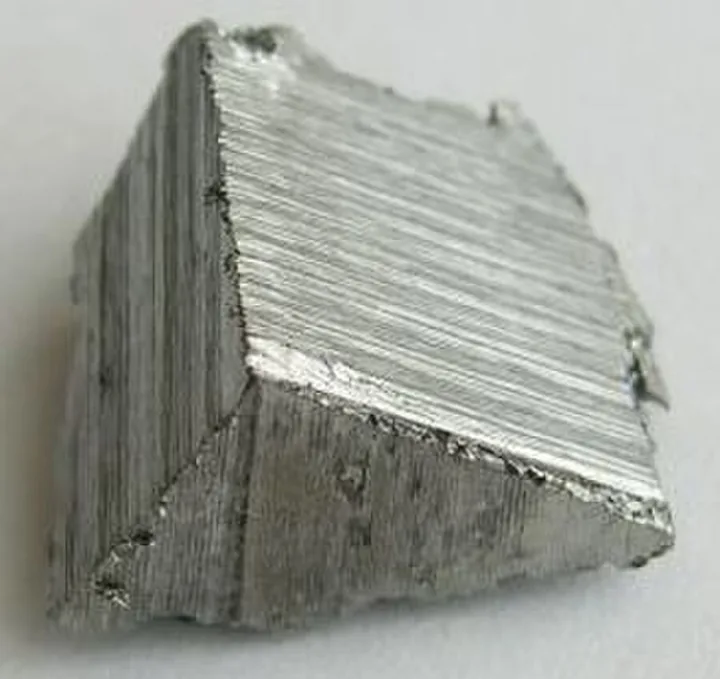
1Identity card
- Atomic number
- 68protons in the nucleus
- Symbol
- Er
- Atomic weight
- 167.26 uIUPAC standard value : 167.259
- Family
- Lanthanides
- Group · period · block
- — (lanthanides) · 6 · f
- State at 20 °C
- solid
- Melting point
- 1,529 °C
- Boiling point
- 2,868 °C
- Density
- 9.07 g/cm³at 20 °C
- Electronegativity
- 1.24Pauling scale
- Electron configuration
- [Xe] 4f12 6s2
- Electrons per shell
- 2 · 8 · 18 · 30 · 8 · 2
- Earth’s crust
- 3.5 g per tonne
- Discovery
- 1843Carl Gustaf Mosander
- Place
- Stockholm (Sweden)
2The erbium atom
An atom of erbium has 68 protons in its nucleus and, when neutral, as many electrons, spread over 6 shells.
3Discovery
In 1843, in Stockholm, Carl Gustaf Mosander separated from yttria a pinkish “earth” he first called terbia; after a mix-up the names were swapped and it became erbia. Reasonably pure metal was not obtained until 1934.
4Origin of the name
From Ytterby, the Swedish village that gave its name to four elements.
5Where is it found?
It is extracted with the other rare earths, notably from the clays of southern China and from xenotime.
6Uses
- Erbium-doped fibre amplifiers, which boost the internet’s light signals in undersea cables.
- Medical and cosmetic lasers (Er:YAG) for skin and teeth.
- A pink colouring for glass, sunglasses and cubic zirconia.
7Did you know?
Without erbium, light signals would fade too quickly in the fibres that cross the oceans: it re-amplifies them roughly every 50 to 100 km.
8Isotopes
Six natural isotopes; erbium-166 is the most abundant (about 33%).
Isotopes found in nature and their abundance (CIAAW data)
9Its neighbours in the table
Elements in the same column often have similar chemistry; those in the same row have the same number of electron shells.