Thulium
Thulium · Tm · 69
One of the least abundant lanthanides, a silvery-grey metal. It is used in portable X-ray devices and surgical lasers.
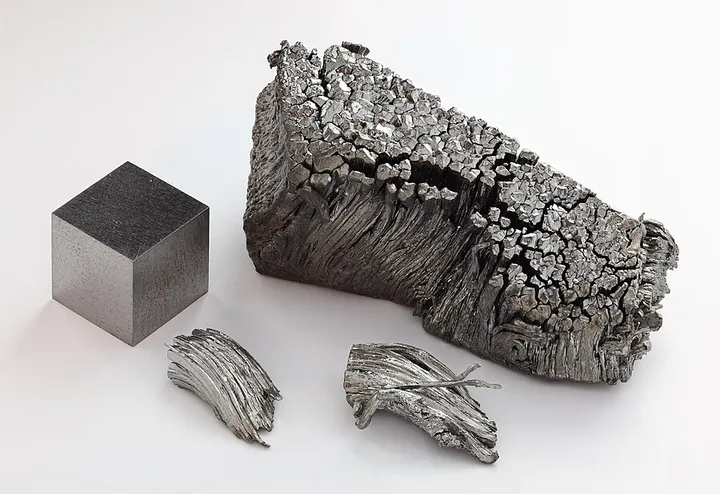
1Identity card
- Atomic number
- 69protons in the nucleus
- Symbol
- Tm
- Atomic weight
- 168.93 uIUPAC standard value : 168.934219
- Family
- Lanthanides
- Group · period · block
- — (lanthanides) · 6 · f
- State at 20 °C
- solid
- Melting point
- 1,545 °C
- Boiling point
- 1,950 °C
- Density
- 9.32 g/cm³at 20 °C
- Electronegativity
- 1.25Pauling scale
- Electron configuration
- [Xe] 4f13 6s2
- Electrons per shell
- 2 · 8 · 18 · 31 · 8 · 2
- Earth’s crust
- 520 mg per tonne
- Discovery
- 1879Per Teodor Cleve
- Place
- Uppsala (Sweden)
2The thulium atom
An atom of thulium has 69 protons in its nucleus and, when neutral, as many electrons, spread over 6 shells.
3Discovery
In 1879, in Uppsala, Per Teodor Cleve studied erbia and found two hidden elements in it, holmium and thulium. The pure metal was not prepared until the 20th century.
4Origin of the name
From Thule, the name ancient geographers gave to a distant land in the far North, associated with Scandinavia.
5Where is it found?
Although rare among the rare earths, thulium is more abundant in the Earth’s crust than silver or iodine. It is extracted mainly from monazite.
6Uses
- Portable X-ray sources (thulium-170) for field radiography.
- Thulium fibre lasers for surgery.
- Research on magnetic materials and superconductivity.
7Did you know?
Its high price, due to its rarity and difficult separation, greatly limits its uses.
8Isotopes
One stable isotope, thulium-169.
Isotopes found in nature and their abundance (CIAAW data)
9Its neighbours in the table
Elements in the same column often have similar chemistry; those in the same row have the same number of electron shells.