Europium
Europium · Eu · 63
The most reactive of the lanthanides, which oxidises in air within days. Its compounds give off red or blue light under ultraviolet, used in screens and against forged banknotes.
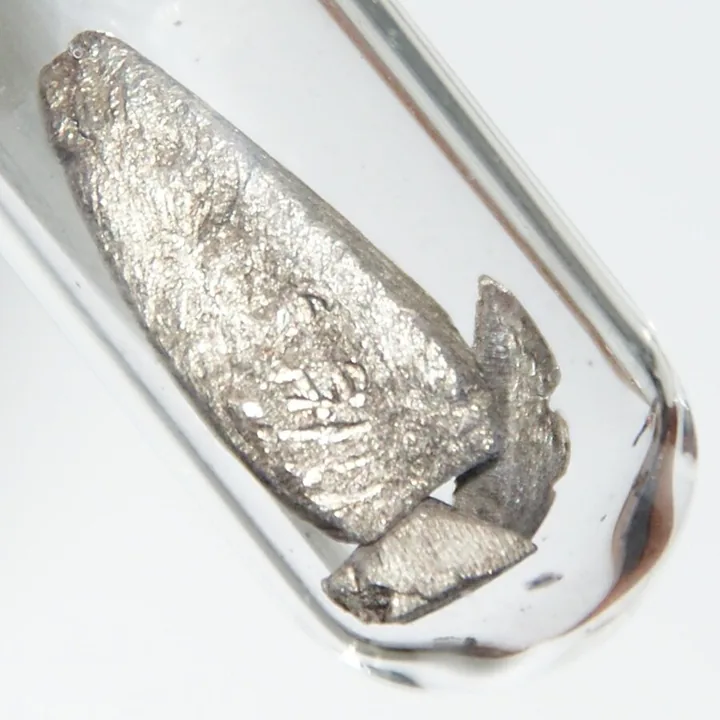
1Identity card
- Atomic number
- 63protons in the nucleus
- Symbol
- Eu
- Atomic weight
- 151.96 uIUPAC standard value : 151.964
- Family
- Lanthanides
- Group · period · block
- — (lanthanides) · 6 · f
- State at 20 °C
- solid
- Melting point
- 822 °C
- Boiling point
- 1,529 °C
- Density
- 5.24 g/cm³at 20 °C
- Electronegativity
- not defined
- Electron configuration
- [Xe] 4f7 6s2
- Electrons per shell
- 2 · 8 · 18 · 25 · 8 · 2
- Earth’s crust
- 2.0 g per tonne
- Discovery
- 1901Eugène-Anatole Demarçay
- Place
- Paris (France)
2The europium atom
An atom of europium has 63 protons in its nucleus and, when neutral, as many electrons, spread over 6 shells.
3Discovery
The Frenchman Eugène-Anatole Demarçay, a spectroscopy specialist, suspected as early as 1896 that an element was hiding in samarium. In 1901, in Paris, he succeeded in isolating it as an oxide.
4Origin of the name
From Europe, its discoverer’s continent.
5Where is it found?
It is one of the least abundant lanthanides; it is extracted from bastnäsite and monazite.
6Uses
- Red and blue phosphors in old television screens, fluorescent lamps and some LEDs.
- Security inks that glow under ultraviolet light, on banknotes and official documents.
- Control rods in nuclear reactors.
7Did you know?
Under an ultraviolet lamp, hidden patterns appear on euro banknotes; some are thought to contain europium compounds, but the exact recipe is secret.
8Isotopes
Two natural isotopes, europium-151 (about 48%) and europium-153 (about 52%).
Isotopes found in nature and their abundance (CIAAW data)
9Its neighbours in the table
Elements in the same column often have similar chemistry; those in the same row have the same number of electron shells.