Zinc
Zinc · Zn · 30
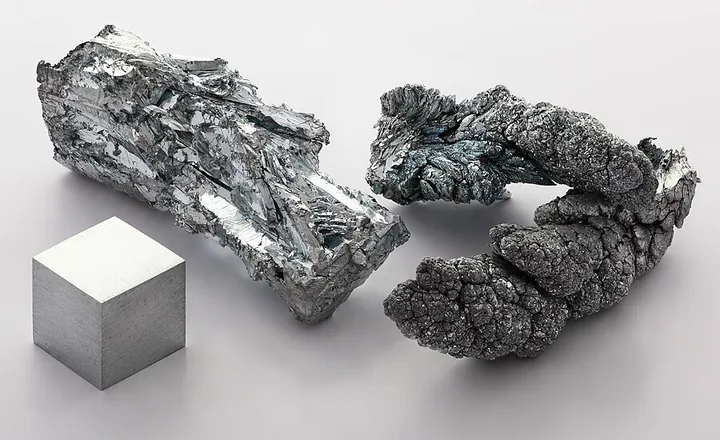
A bluish-grey metal that protects steel from rust by sacrificing itself instead. It covers the roofs of Paris, goes into brass and plays an essential role in our bodies.
1Identity card
- Atomic number
- 30protons in the nucleus
- Symbol
- Zn
- Atomic weight
- 65.38 uIUPAC standard value
- Family
- Transition metals
- Group · period · block
- 12 · 4 · d
- State at 20 °C
- solid
- Melting point
- 419.53 °C
- Boiling point
- 907 °C
- Density
- 7.14 g/cm³at 20 °C
- Electronegativity
- 1.65Pauling scale
- Electron configuration
- [Ar] 3d10 4s2
- Electrons per shell
- 2 · 8 · 18 · 2
- Earth’s crust
- 70 g per tonne
- Discovery
- 1746Andreas Sigismund Marggraf (known much earlier in India and China)
- Place
- Berlin (Germany)
2The zinc atom
An atom of zinc has 30 protons in its nucleus and, when neutral, as many electrons, spread over 4 shells.
3Discovery
Brass, an alloy of copper and zinc, was made in antiquity from a zinc ore, calamine, without the metal itself being isolated. Metallic zinc was produced in India, at Zawar, from around the 12th century, and then in China.
In Europe, the Englishman William Champion set up a zinc smelter in Bristol in 1738, and the German chemist Andreas Sigismund Marggraf described an extraction method in Berlin in 1746 that established zinc as a metal in its own right.
4Origin of the name
From the German Zink, perhaps from Zinke, “tooth, prong”, because of the shape of its crystals; the word appears in Paracelsus in the 16th century.
5Where is it found?
Zinc is extracted mainly from sphalerite (zinc blende), a zinc sulfide, in China, Peru and Australia. The human body contains 2 to 3 grams; it is needed by hundreds of enzymes and by the immune system.
6Uses
- Galvanising: a layer of zinc protects the steel of crash barriers, fences and car bodies from rust (about half of use).
- Brass and other alloys.
- Zinc roofing and gutters.
- Zinc oxide in sunscreens and ointments, and alkaline batteries.
7Did you know?
The grey roofs of Parisian buildings are mostly covered in zinc, a signature of the city’s skyline since the 19th century.
In 1800 Alessandro Volta stacked discs of zinc and copper separated by wet cardboard: it was the first electric battery.
8Isotopes
Five stable isotopes; zinc-64 makes up nearly half.
Isotopes found in nature and their abundance (CIAAW data)
9Emission spectrum
As a gas or vapour, when heated or crossed by an electric current, zinc atoms give off light at a few very precise wavelengths: these are their lines, a true barcode of the element. Several elements were discovered by observing such lines in a spectroscope.
For listening, each light frequency is divided by 2⁴⁰: the light is transposed down forty octaves, which keeps the exact ratios between the lines. Point to or tap a line to hear it alone.
10Its neighbours in the table
Elements in the same column often have similar chemistry; those in the same row have the same number of electron shells.