Silver
Argent · Ag · 47
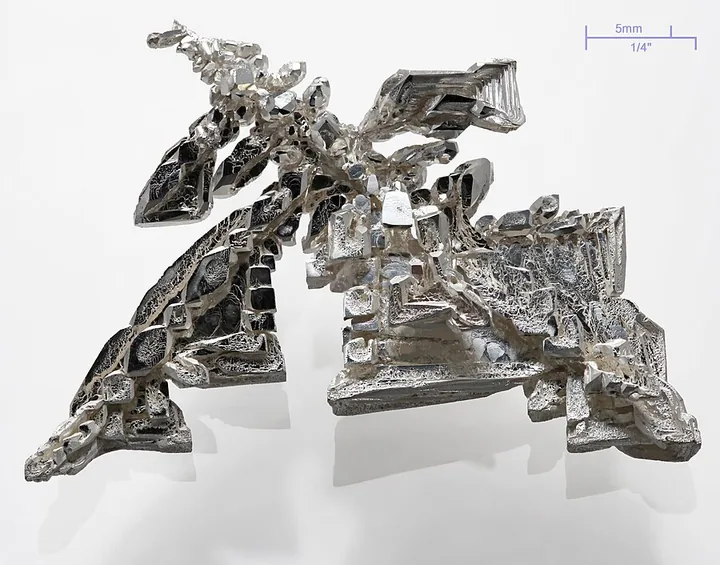
The shiny white metal of jewellery, cutlery and coins. It is the best conductor of electricity and heat of all the elements.
1Identity card
- Atomic number
- 47protons in the nucleus
- Symbol
- Ag
- Atomic weight
- 107.87 uIUPAC standard value : 107.8682
- Family
- Transition metals
- Group · period · block
- 11 · 5 · d
- State at 20 °C
- solid
- Melting point
- 961.78 °C
- Boiling point
- 2,162 °C
- Density
- 10.49 g/cm³at 20 °C
- Electronegativity
- 1.93Pauling scale
- Electron configuration
- [Kr] 4d10 5s1
- Electrons per shell
- 2 · 8 · 18 · 18 · 1
- Earth’s crust
- 75 mg per tonne
- Discovery
- Known since antiquity
2The silver atom
An atom of silver has 47 protons in its nucleus and, when neutral, as many electrons, spread over 5 shells.
3Discovery
Silver has been worked for at least 5,000 years, in Anatolia and Mesopotamia. In antiquity the Laurion mines near Athens paid for the fleet that defeated the Persians at Salamis in 480 BCE.
In the 16th century the “silver mountain” of Potosí, in today’s Bolivia, became the largest mine in the world, at the cost of the lives of very many Indigenous workers.
4Origin of the name
The English word is Germanic; the symbol Ag comes from the Latin argentum, from a root meaning “white, shining”. Argentina owes its name to silver, which explorers hoped to find there.
5Where is it found?
Native silver is sometimes found, but it is mostly produced as a by-product of lead, zinc, copper and gold mines. Mexico, Peru and China are the leading producers.
6Uses
- Electronics and solar panels, where a silver paste collects the current.
- Jewellery, silverware, commemorative coins.
- Mirrors and heat-reflecting glazing.
- Antibacterial dressings and textiles.
- Formerly, film photography (silver bromide in film).
7Did you know?
Silver tarnishes over time because it reacts with traces of sulfur in the air, forming a thin layer of silver sulfide.
8Isotopes
Two stable isotopes in almost equal amounts, silver-107 (about 52%) and silver-109 (about 48%).
Isotopes found in nature and their abundance (CIAAW data)
9Its neighbours in the table
Elements in the same column often have similar chemistry; those in the same row have the same number of electron shells.