Platinum
Platine · Pt · 78
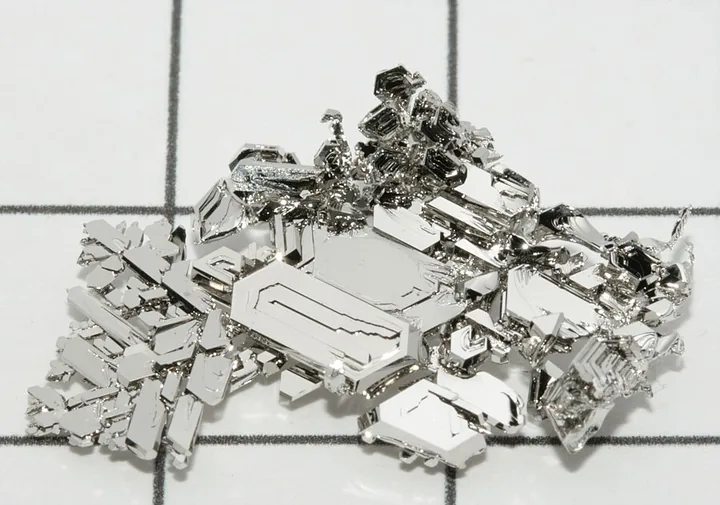
A dense, silvery-white precious metal that never tarnishes and is an excellent catalyst. It cleans exhaust gases, treats some cancers and long served as the standard for the kilogram.
1Identity card
- Atomic number
- 78protons in the nucleus
- Symbol
- Pt
- Atomic weight
- 195.08 uIUPAC standard value : 195.084
- Family
- Transition metals
- Group · period · block
- 10 · 6 · d
- State at 20 °C
- solid
- Melting point
- 1,768.2 °C
- Boiling point
- 3,825 °C
- Density
- 21.45 g/cm³at 20 °C
- Electronegativity
- 2.28Pauling scale
- Electron configuration
- [Xe] 4f14 5d9 6s1
- Electrons per shell
- 2 · 8 · 18 · 32 · 17 · 1
- Earth’s crust
- 5.0 mg per tonne
- Discovery
- 1748Antonio de Ulloa (known much earlier to peoples of South America)
- Place
- New Granada (today’s Colombia) and Madrid (Spain)
2The platinum atom
An atom of platinum has 78 protons in its nucleus and, when neutral, as many electrons, spread over 6 shells.
3Discovery
Peoples of South America, on the coast of what is now Ecuador, were already working platinum–gold alloys long before Europeans arrived. The Spanish, who found this metal in the gold-bearing sands of Colombia, considered it a nuisance and called it platina, “little silver”.
The Spanish scientist Antonio de Ulloa described it in 1748, and samples reached England in the 1740s. At the end of the 18th century Pierre-François Chabaneau managed, in Madrid, to make it malleable.
4Origin of the name
From the Spanish platina, “little silver”, a diminutive of plata.
5Where is it found?
Platinum is mined mainly in South Africa, in the huge Bushveld deposit, and in Russia.
6Uses
- Catalytic converters, notably in diesel engines.
- Jewellery and bullion.
- Anti-cancer drugs (cisplatin and related compounds).
- Laboratory equipment, electrodes, temperature sensors, fuel cells.
7Did you know?
From 1889 to 2019 the kilogram was defined by a cylinder of platinum and iridium kept at the International Bureau of Weights and Measures in Sèvres, near Paris.
Cisplatin was discovered by chance in 1965: bacteria stopped dividing near platinum electrodes.
8Isotopes
Six natural isotopes; platinum-195 (about 34%) and platinum-194 (about 33%) are the most abundant.
Isotopes found in nature and their abundance (CIAAW data)
9Its neighbours in the table
Elements in the same column often have similar chemistry; those in the same row have the same number of electron shells.