Iridium
Iridium · Ir · 77
The most corrosion-resistant metal, almost as dense as osmium. A thin iridium-rich layer in rocks all over the world tells the story of the asteroid that wiped out the dinosaurs.
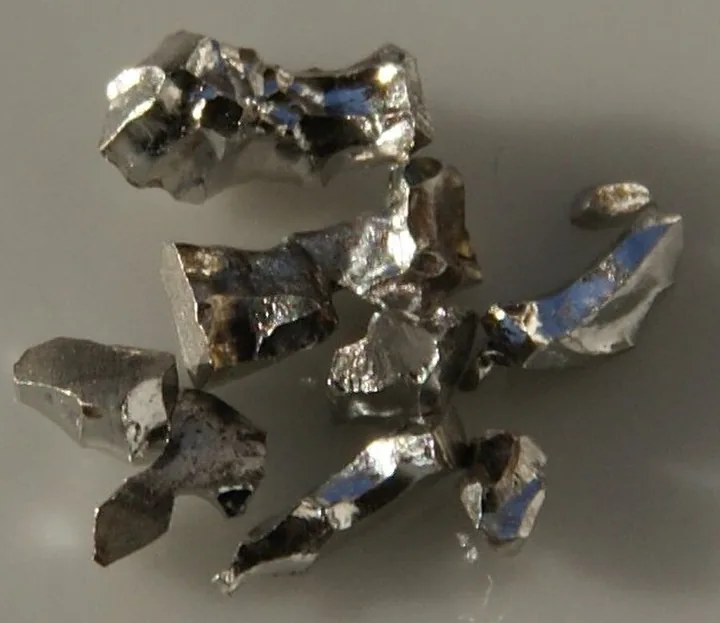
1Identity card
- Atomic number
- 77protons in the nucleus
- Symbol
- Ir
- Atomic weight
- 192.22 uIUPAC standard value : 192.217
- Family
- Transition metals
- Group · period · block
- 9 · 6 · d
- State at 20 °C
- solid
- Melting point
- 2,446 °C
- Boiling point
- 4,428 °C
- Density
- 22.56 g/cm³at 20 °C
- Electronegativity
- 2.2Pauling scale
- Electron configuration
- [Xe] 4f14 5d7 6s2
- Electrons per shell
- 2 · 8 · 18 · 32 · 15 · 2
- Earth’s crust
- 1.0 mg per tonne
- Discovery
- 1803Smithson Tennant
- Place
- London (England)
2The iridium atom
An atom of iridium has 77 protons in its nucleus and, when neutral, as many electrons, spread over 6 shells.
3Discovery
In 1803, in London, Smithson Tennant discovered iridium at the same time as osmium, in the black residue left after dissolving crude platinum.
4Origin of the name
From Iris, the Greek goddess of the rainbow, because its salts take on many different colours.
5Where is it found?
It is one of the rarest elements in the Earth’s crust, extracted with platinum in South Africa. It is much more abundant in meteorites.
6Uses
- Tips of high-end spark plugs.
- Crucibles for growing sapphire and other crystals.
- Iridium-192 for industrial radiography and some radiotherapy.
- Electrodes for making hydrogen by electrolysis.
7Did you know?
In 1980 Luis and Walter Alvarez found a 66-million-year-old clay layer very rich in iridium and concluded that a giant asteroid struck the Earth at the end of the age of the dinosaurs.
The international prototype metre of 1889 was a bar made of 90% platinum and 10% iridium.
8Isotopes
Two stable isotopes, iridium-191 (about 37%) and iridium-193 (about 63%).
Isotopes found in nature and their abundance (CIAAW data)
9Its neighbours in the table
Elements in the same column often have similar chemistry; those in the same row have the same number of electron shells.