Osmium
Osmium · Os · 76
The densest natural element, an extremely hard, bluish metal. It is used in ultra-tough alloys, but its volatile oxide is very toxic.
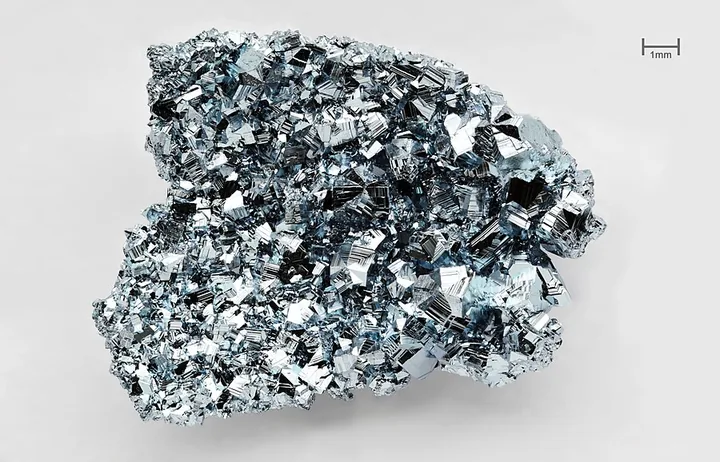
1Identity card
- Atomic number
- 76protons in the nucleus
- Symbol
- Os
- Atomic weight
- 190.23 uIUPAC standard value
- Family
- Transition metals
- Group · period · block
- 8 · 6 · d
- State at 20 °C
- solid
- Melting point
- 3,033 °C
- Boiling point
- 5,012 °C
- Density
- 22.59 g/cm³at 20 °C
- Electronegativity
- 2.2Pauling scale
- Electron configuration
- [Xe] 4f14 5d6 6s2
- Electrons per shell
- 2 · 8 · 18 · 32 · 14 · 2
- Earth’s crust
- 1.5 mg per tonne
- Discovery
- 1803Smithson Tennant
- Place
- London (England)
2The osmium atom
An atom of osmium has 76 protons in its nucleus and, when neutral, as many electrons, spread over 6 shells.
3Discovery
In 1803, in London, Smithson Tennant examined the black powder left behind when crude platinum is dissolved in aqua regia. He discovered two new metals in it, osmium and iridium.
4Origin of the name
From the Greek osmē, “smell”, because of the pungent odour of its oxide, which forms easily in air.
5Where is it found?
Extremely rare, it is recovered with the other platinum-group metals in South Africa and Russia.
6Uses
- Very hard alloys for fountain-pen tips, instrument pivots and electrical contacts.
- Osmium tetroxide, a stain for tissues in electron microscopy and a fingerprint developer.
7Did you know?
A litre of osmium would weigh more than 22 kilograms, twice as much as a litre of lead.
Safety: Osmium tetroxide is very toxic, especially to the eyes.
8Isotopes
Seven natural isotopes; osmium-192 is the most abundant (about 41%).
Isotopes found in nature and their abundance (CIAAW data)
9Its neighbours in the table
Elements in the same column often have similar chemistry; those in the same row have the same number of electron shells.