Rhenium
Rhénium · Re · 75
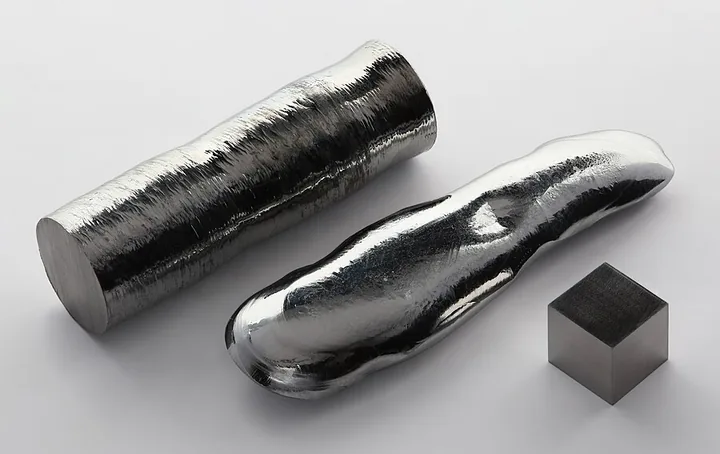
One of the rarest elements in the Earth’s crust, a very dense, silvery metal that withstands extreme temperatures. It strengthens the turbine blades of jet engines.
1Identity card
- Atomic number
- 75protons in the nucleus
- Symbol
- Re
- Atomic weight
- 186.21 uIUPAC standard value : 186.207
- Family
- Transition metals
- Group · period · block
- 7 · 6 · d
- State at 20 °C
- solid
- Melting point
- 3,186 °C
- Boiling point
- 5,596 °C
- Density
- 21.02 g/cm³at 20 °C
- Electronegativity
- 1.9Pauling scale
- Electron configuration
- [Xe] 4f14 5d5 6s2
- Electrons per shell
- 2 · 8 · 18 · 32 · 13 · 2
- Earth’s crust
- minute traces
- Discovery
- 1925Walter Noddack, Ida Tacke (Ida Noddack), Otto Berg
- Place
- Berlin (Germany)
2The rhenium atom
An atom of rhenium has 75 protons in its nucleus and, when neutral, as many electrons, spread over 6 shells.
3Discovery
In 1925, in Berlin, Walter Noddack, Ida Tacke and Otto Berg detected a new element by X-ray spectroscopy in platinum and columbite ores. They extracted one gram of it in 1928, from 660 kilograms of molybdenite.
It was the last element with a stable isotope to be discovered. Ida Tacke, who became Ida Noddack, also suggested in 1934, long before anyone else, that uranium might break into pieces: the idea of fission.
4Origin of the name
From Rhenus, the Latin name of the Rhine, the great German river.
5Where is it found?
It is recovered as a by-product of molybdenum mined from copper deposits, mainly in Chile. A rhenium mineral was discovered in 1994 on a volcano in the Kuril Islands.
6Uses
- Nickel superalloys for jet-engine turbine blades (about 80% of use).
- Platinum–rhenium catalysts for making high-octane petrol.
- Thermocouples and filaments for very high temperatures.
7Did you know?
Rhenium-187, its most abundant isotope, is radioactive: it very slowly turns into osmium, which is used to date ores and meteorites.
8Isotopes
Two natural isotopes, rhenium-185 (about 37%), stable, and rhenium-187 (about 63%), radioactive with a half-life of about 41 billion years.
Isotopes found in nature and their abundance (CIAAW data)
9Its neighbours in the table
Elements in the same column often have similar chemistry; those in the same row have the same number of electron shells.