Tungsten
Tungstène · W · 74
The metal with the highest melting point, 3,422 °C, and one of the densest. It lit up the world in light-bulb filaments and today equips the hardest cutting tools.
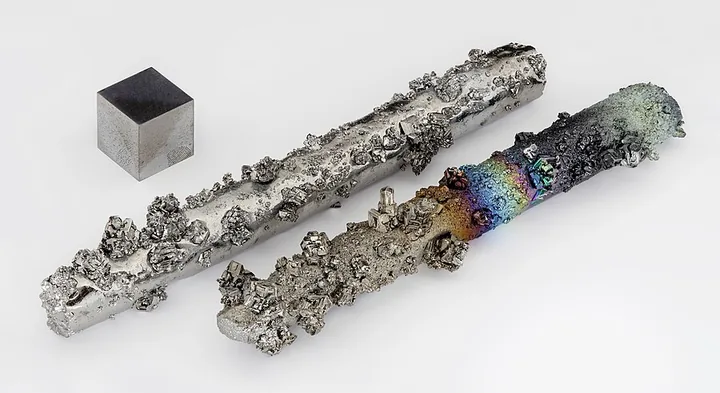
1Identity card
- Atomic number
- 74protons in the nucleus
- Symbol
- W
- Atomic weight
- 183.84 uIUPAC standard value
- Family
- Transition metals
- Group · period · block
- 6 · 6 · d
- State at 20 °C
- solid
- Melting point
- 3,422 °C
- Boiling point
- 5,555 °C
- Density
- 19.25 g/cm³at 20 °C
- Electronegativity
- 2.36Pauling scale
- Electron configuration
- [Xe] 4f14 5d4 6s2
- Electrons per shell
- 2 · 8 · 18 · 32 · 12 · 2
- Earth’s crust
- 1.2 g per tonne
- Discovery
- 1783Juan José and Fausto Elhuyar
- Place
- Bergara (Spain)
2The tungsten atom
An atom of tungsten has 74 protons in its nucleus and, when neutral, as many electrons, spread over 6 shells.
3Discovery
In 1781, in Sweden, Carl Wilhelm Scheele obtained a new acid from a heavy mineral now called scheelite. Two years later, in Bergara in the Spanish Basque Country, the brothers Juan José and Fausto Elhuyar isolated the metal from another ore, wolframite, by heating it with charcoal.
Want to know more about Scheele and other scientists? Visit Les inventeurs, a sister site devoted to scientists and their inventions (in French).
4Origin of the name
From the Swedish tung sten, “heavy stone”. The symbol W comes from its other name, wolfram, from wolframite: German smelters said this ore “devoured” tin like a wolf (Wolf).
5Where is it found?
It is extracted from wolframite and scheelite, mainly in China, which produces more than 80% of the world’s supply.
6Uses
- Tungsten carbide drill bits, milling cutters and cutting tools (about 60% of use).
- Incandescent bulb filaments and welding electrodes.
- Heavy alloys: counterweights, darts, the weights in phone vibration motors.
- Anodes of X-ray tubes.
7Did you know?
Tungsten has almost the same density as gold: swindlers have made fake bars by casting gold around a tungsten core.
In an incandescent bulb, the tungsten filament heats up to about 2,500 °C without melting.
8Isotopes
Five natural isotopes; tungsten-184 and tungsten-186 are the most abundant.
Isotopes found in nature and their abundance (CIAAW data)
9Its neighbours in the table
Elements in the same column often have similar chemistry; those in the same row have the same number of electron shells.