Niobium
Niobium · Nb · 41
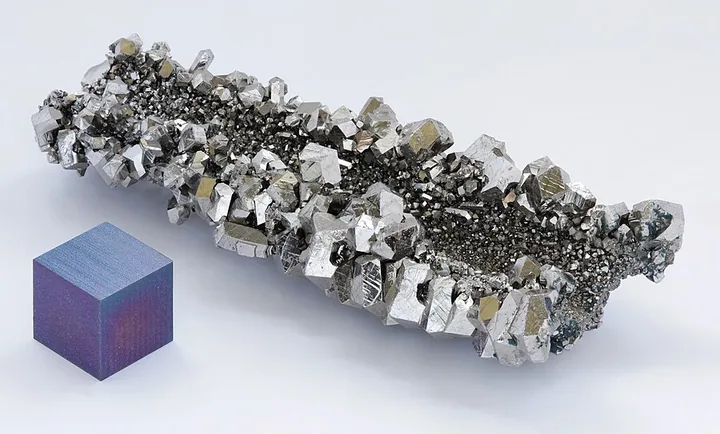
A ductile grey metal that becomes superconducting at low temperatures. A pinch of niobium makes steel stronger and lighter, and its alloys create the magnetic fields of MRI scanners.
1Identity card
- Atomic number
- 41protons in the nucleus
- Symbol
- Nb
- Atomic weight
- 92.906 uIUPAC standard value : 92.90637
- Family
- Transition metals
- Group · period · block
- 5 · 5 · d
- State at 20 °C
- solid
- Melting point
- 2,477 °C
- Boiling point
- 4,744 °C
- Density
- 8.57 g/cm³at 20 °C
- Electronegativity
- 1.6Pauling scale
- Electron configuration
- [Kr] 4d4 5s1
- Electrons per shell
- 2 · 8 · 18 · 12 · 1
- Earth’s crust
- 20 g per tonne
- Discovery
- 1801Charles Hatchett
- Place
- London (England)
2The niobium atom
An atom of niobium has 41 protons in its nucleus and, when neutral, as many electrons, spread over 5 shells.
3Discovery
In 1801, in London, Charles Hatchett analysed a black mineral from Connecticut kept at the British Museum. He found a new element in it and called it columbium. Soon after, it was confused with tantalum, which it closely resembles.
In 1844 the German Heinrich Rose showed that they were indeed two separate elements and named the second one niobium. The two names coexisted for a century, until IUPAC chose “niobium” in 1949.
4Origin of the name
From Niobe, daughter of Tantalus in Greek mythology, because it is inseparable from tantalum.
5Where is it found?
Niobium is extracted mainly from pyrochlore. Brazil alone supplies about 90% of world production, ahead of Canada.
6Uses
- Micro-alloyed steels for gas pipelines, bridges and car bodies.
- Superconducting magnets (niobium–titanium) in MRI scanners and accelerators such as the LHC.
- Superalloys for jet and rocket engines.
- Jewellery and piercings, coloured by anodising.
7Did you know?
The thousands of magnets that steer protons around the 27 km ring of CERN’s LHC are made of niobium–titanium cables cooled to −271 °C.
8Isotopes
One stable isotope, niobium-93.
Isotopes found in nature and their abundance (CIAAW data)
9Its neighbours in the table
Elements in the same column often have similar chemistry; those in the same row have the same number of electron shells.