Titanium
Titane · Ti · 22
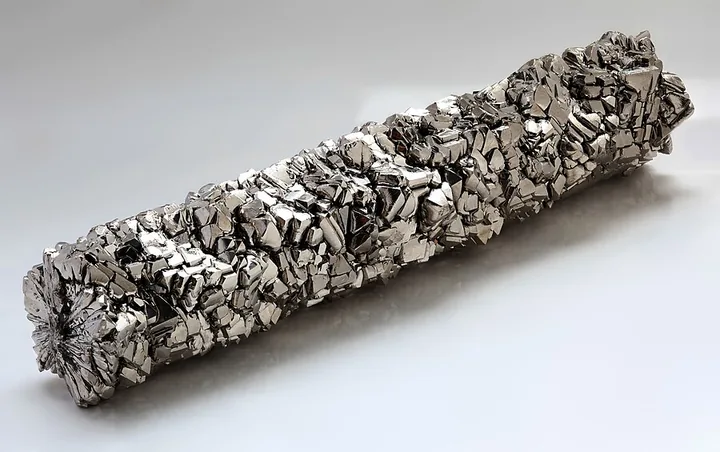
A grey metal as strong as steel but almost half as heavy, which does not rust and is very well tolerated by the human body. As an oxide, it is the most widely used white pigment in the world.
1Identity card
- Atomic number
- 22protons in the nucleus
- Symbol
- Ti
- Atomic weight
- 47.867 uIUPAC standard value
- Family
- Transition metals
- Group · period · block
- 4 · 4 · d
- State at 20 °C
- solid
- Melting point
- 1,668 °C
- Boiling point
- 3,287 °C
- Density
- 4.506 g/cm³at 20 °C
- Electronegativity
- 1.54Pauling scale
- Electron configuration
- [Ar] 3d2 4s2
- Electrons per shell
- 2 · 8 · 10 · 2
- Earth’s crust
- 5,600 g per tonne
- Discovery
- 1791William Gregor; Martin Heinrich Klaproth (1795)
- Place
- Cornwall (England) and Berlin (Germany)
2The titanium atom
An atom of titanium has 22 protons in its nucleus and, when neutral, as many electrons, spread over 4 shells.
3Discovery
In 1791 the clergyman and amateur mineralogist William Gregor examined a magnetic black sand from a Cornish stream and found the oxide of an unknown metal in it. Four years later, in Berlin, Martin Heinrich Klaproth found the same element in rutile and gave it its name.
The pure metal is very hard to obtain: it was only prepared in 1910 by Matthew Hunter in the United States, and produced in large quantities only after the invention of the Kroll process in the late 1930s.
Want to know more about Klaproth and other scientists? Visit Les inventeurs, a sister site devoted to scientists and their inventions (in French).
4Origin of the name
From the Titans, giants of Greek mythology, children of Ouranos (the Sky) and Gaia (the Earth). Klaproth had already named uranium after Ouranos.
5Where is it found?
The ninth most abundant element in the Earth’s crust, titanium is found mainly in ilmenite and rutile, mined notably in China, Australia, South Africa and Mozambique.
Some of the rocks brought back from the Moon by the Apollo missions are very rich in titanium.
6Uses
- Titanium dioxide: the white pigment in paints, plastics, paper and sunscreens (the main use of the ore).
- Aerospace: engines, landing gear, airframes.
- Medical and dental implants and hip replacements, as the body tolerates it well.
- Spectacle frames, watches, bicycle frames, submarine hulls.
7Did you know?
The Guggenheim Museum in Bilbao, opened in 1997, is clad in thousands of thin titanium panels that change colour with the light.
The American SR-71 spy plane, one of the fastest aircraft ever, was built almost entirely of titanium… some of it quietly bought from the Soviet Union.
8Isotopes
Five stable isotopes; titanium-48 makes up nearly three quarters of natural titanium.
Isotopes found in nature and their abundance (CIAAW data)
9Its neighbours in the table
Elements in the same column often have similar chemistry; those in the same row have the same number of electron shells.