Zirconium
Zirconium · Zr · 40
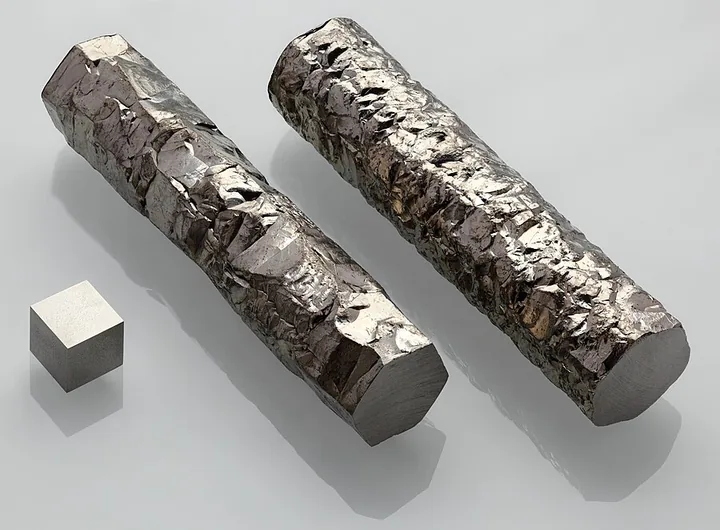
A strong, grey metal, very resistant to corrosion, that lets neutrons pass. It sheathes the fuel in nuclear reactors, and its oxide imitates diamond.
1Identity card
- Atomic number
- 40protons in the nucleus
- Symbol
- Zr
- Atomic weight
- 91.224 uIUPAC standard value
- Family
- Transition metals
- Group · period · block
- 4 · 5 · d
- State at 20 °C
- solid
- Melting point
- 1,855 °C
- Boiling point
- 4,409 °C
- Density
- 6.52 g/cm³at 20 °C
- Electronegativity
- 1.33Pauling scale
- Electron configuration
- [Kr] 4d2 5s2
- Electrons per shell
- 2 · 8 · 18 · 10 · 2
- Earth’s crust
- 160 g per tonne
- Discovery
- 1789Martin Heinrich Klaproth
- Place
- Berlin (Germany)
2The zirconium atom
An atom of zirconium has 40 protons in its nucleus and, when neutral, as many electrons, spread over 5 shells.
3Discovery
Zircon is a gemstone known since antiquity. In 1789, in Berlin, Martin Heinrich Klaproth analysed a zircon from Ceylon (Sri Lanka) and found the oxide of a new element, zirconia.
Jöns Jacob Berzelius isolated impure zirconium in 1824; truly pure metal was not obtained until 1925.
Want to know more about Berzelius, Klaproth and other scientists? Visit Les inventeurs, a sister site devoted to scientists and their inventions (in French).
4Origin of the name
From zircon, a name derived from the Persian zargun, “gold-coloured”.
5Where is it found?
Zirconium comes almost entirely from zircon, extracted from mineral sands in Australia and South Africa. Some zircon grains from Western Australia, 4.4 billion years old, are the oldest known fragments of the Earth’s crust.
6Uses
- Cladding for nuclear fuel (zirconium alloys), because it absorbs very few neutrons.
- Ceramics, refractories and foundry sands.
- Zirconia dental crowns and implants, strong and natural-looking.
- Cubic zirconia, an inexpensive imitation of diamond.
- Acid-resistant chemical equipment.
7Did you know?
Cubic zirconia is so brilliant that a trained eye or an instrument is needed to tell it from a real diamond.
8Isotopes
Five natural isotopes; zirconium-90 makes up about half.
Isotopes found in nature and their abundance (CIAAW data)
9Its neighbours in the table
Elements in the same column often have similar chemistry; those in the same row have the same number of electron shells.