Hafnium
Hafnium · Hf · 72
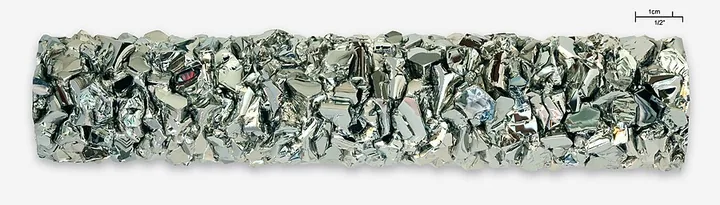
A silvery-grey metal, the chemical twin of zirconium, from which it is very hard to separate. It absorbs neutrons in nuclear reactors and insulates the tiny transistors in processors.
1Identity card
- Atomic number
- 72protons in the nucleus
- Symbol
- Hf
- Atomic weight
- 178.49 uIUPAC standard value : 178.486
- Family
- Transition metals
- Group · period · block
- 4 · 6 · d
- State at 20 °C
- solid
- Melting point
- 2,233 °C
- Boiling point
- 4,603 °C
- Density
- 13.31 g/cm³at 20 °C
- Electronegativity
- 1.3Pauling scale
- Electron configuration
- [Xe] 4f14 5d2 6s2
- Electrons per shell
- 2 · 8 · 18 · 32 · 10 · 2
- Earth’s crust
- 3.0 g per tonne
- Discovery
- 1923Dirk Coster, George de Hevesy
- Place
- Copenhagen (Denmark)
2The hafnium atom
An atom of hafnium has 72 protons in its nucleus and, when neutral, as many electrons, spread over 6 shells.
3Discovery
In 1923, in Copenhagen, at Niels Bohr’s institute, Dirk Coster and George de Hevesy followed a prediction of the new atomic physics: element 72 should not be a rare earth but a cousin of zirconium. So they looked for it in zirconium ores and found it through its X-ray spectrum.
It was a resounding success for Bohr’s theory, and one of the last stable elements to be found.
Want to know more about Bohr and other scientists? Visit Les inventeurs, a sister site devoted to scientists and their inventions (in French).
4Origin of the name
From Hafnia, the Latin name of Copenhagen, the city where it was discovered.
5Where is it found?
Hafnium always accompanies zirconium in zircon, at about 1 to 4%. It is obtained as a by-product of purifying zirconium for the nuclear industry.
6Uses
- Control rods in nuclear reactors, as it absorbs neutrons very well.
- Hafnium oxide, the insulator in the transistors of modern processors.
- Superalloys for jet engines, and plasma-cutting electrodes.
7Did you know?
Zirconium lets neutrons through while hafnium absorbs them: for nuclear fuel cladding, almost all the hafnium must be removed from zirconium, a very delicate separation.
8Isotopes
Six natural isotopes; hafnium-180 is the most abundant (about 35%).
Isotopes found in nature and their abundance (CIAAW data)
9Its neighbours in the table
Elements in the same column often have similar chemistry; those in the same row have the same number of electron shells.