Lutetium
Lutécium · Lu · 71
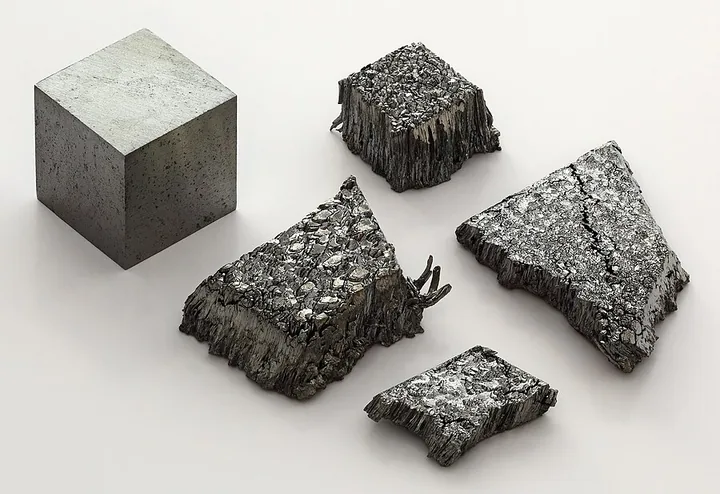
The last and densest of the lanthanides, a hard, silvery metal. It bears the Latin name of Paris and is used today to treat some cancers and to detect tumours.
1Identity card
- Atomic number
- 71protons in the nucleus
- Symbol
- Lu
- Atomic weight
- 174.97 uIUPAC standard value : 174.9668
- Family
- Lanthanides
- Group · period · block
- — (lanthanides) · 6 · f
- State at 20 °C
- solid
- Melting point
- 1,663 °C
- Boiling point
- 3,402 °C
- Density
- 9.84 g/cm³at 20 °C
- Electronegativity
- 1.27Pauling scale
- Electron configuration
- [Xe] 4f14 5d1 6s2
- Electrons per shell
- 2 · 8 · 18 · 32 · 9 · 2
- Earth’s crust
- 800 mg per tonne
- Discovery
- 1907Georges Urbain; Carl Auer von Welsbach; Charles James
- Place
- Paris (France), Vienna (Austria) and New Hampshire (United States)
2The lutetium atom
An atom of lutetium has 71 protons in its nucleus and, when neutral, as many electrons, spread over 6 shells.
3Discovery
In 1907 the Parisian chemist Georges Urbain managed to split Marignac’s ytterbia into two elements. The Austrian Carl Auer von Welsbach and the American Charles James made the same discovery at almost the same time.
Urbain, who published first, won the right to choose the name. It was the last naturally occurring rare earth to be discovered.
4Origin of the name
From Lutetia, the Latin name of Paris, Georges Urbain’s city.
5Where is it found?
It is one of the least abundant lanthanides; it is extracted mainly from monazite and xenotime.
6Uses
- Lutetium-177 in nuclear medicine, to treat some prostate cancers and neuroendocrine tumours.
- Scintillator crystals in positron emission tomography (PET) scanners.
- Oil-refining catalysts.
7Did you know?
Lutetium-176, naturally radioactive, very slowly turns into hafnium: it is used to date meteorites and the oldest rocks on Earth.
8Isotopes
Two natural isotopes, lutetium-175 (about 97.4%), stable, and lutetium-176 (about 2.6%), radioactive, with a half-life of 37 billion years.
Isotopes found in nature and their abundance (CIAAW data)
9Its neighbours in the table
Elements in the same column often have similar chemistry; those in the same row have the same number of electron shells.