Chromium
Chrome · Cr · 24
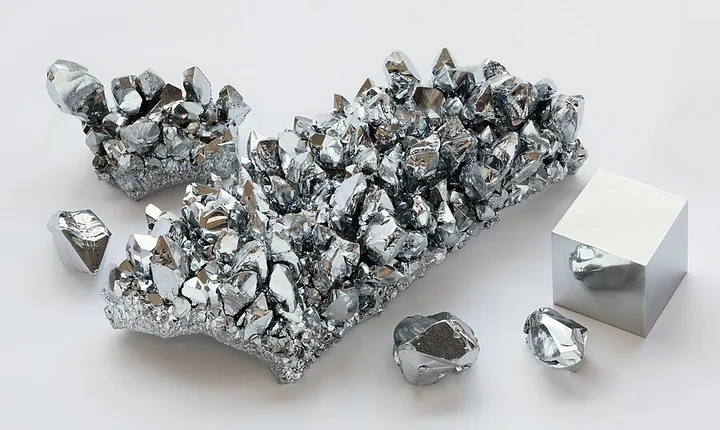
A steel-grey metal, very hard and shiny, that does not tarnish. It makes steel stainless, gives taps their chrome shine and gives ruby and emerald their colour.
1Identity card
- Atomic number
- 24protons in the nucleus
- Symbol
- Cr
- Atomic weight
- 51.996 uIUPAC standard value : 51.9961
- Family
- Transition metals
- Group · period · block
- 6 · 4 · d
- State at 20 °C
- solid
- Melting point
- 1,907 °C
- Boiling point
- 2,671 °C
- Density
- 7.15 g/cm³at 20 °C
- Electronegativity
- 1.66Pauling scale
- Electron configuration
- [Ar] 3d5 4s1
- Electrons per shell
- 2 · 8 · 13 · 1
- Earth’s crust
- 100 g per tonne
- Discovery
- 1797Louis-Nicolas Vauquelin
- Place
- Paris (France)
2The chromium atom
An atom of chromium has 24 protons in its nucleus and, when neutral, as many electrons, spread over 4 shells.
3Discovery
In 1797, in Paris, Louis-Nicolas Vauquelin studied “Siberian red lead”, a bright orange mineral called crocoite. He found in it the oxide of an unknown metal, which he managed to isolate the following year by heating it with charcoal.
4Origin of the name
From the Greek khrōma, “colour”, because its compounds are yellow, orange, green, violet or red.
5Where is it found?
Chromium is extracted from chromite, an iron–chromium oxide, mainly in South Africa, Kazakhstan, India and Turkey.
6Uses
- Stainless steel, which contains at least 10.5% chromium: cutlery, sinks, medical equipment. This is its main use.
- Decorative and protective chrome plating: taps, motorbike parts, tools.
- Green and yellow pigments, and leather tanning.
- Refractory bricks for industrial furnaces.
7Did you know?
Red ruby and green emerald both owe their colour to traces of chromium, in two different minerals.
Modern stainless steel was developed in 1913 in Sheffield, England, by Harry Brearley, who was looking for a steel for gun barrels.
Safety: Hexavalent chromium compounds are highly toxic and carcinogenic; trivalent chromium, on the other hand, is a trace nutrient.
8Isotopes
Four stable isotopes; chromium-52 makes up nearly 84%.
Isotopes found in nature and their abundance (CIAAW data)
9Its neighbours in the table
Elements in the same column often have similar chemistry; those in the same row have the same number of electron shells.