Manganese
Manganèse · Mn · 25
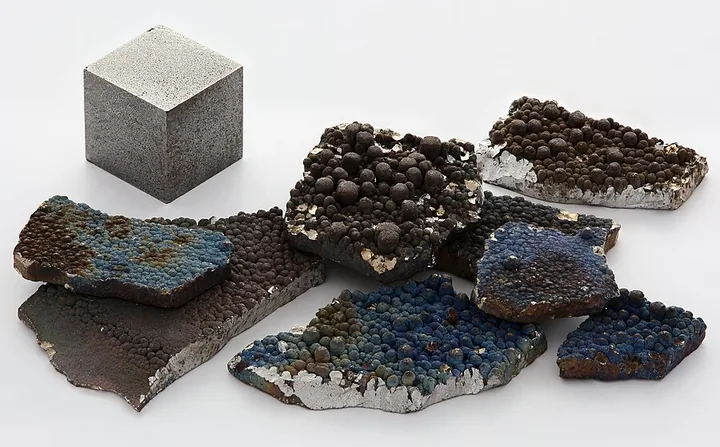
A grey, hard and brittle metal, unassuming but indispensable: without it, hardly any steel could be made. It is also found in batteries and, in tiny amounts, in our bodies.
1Identity card
- Atomic number
- 25protons in the nucleus
- Symbol
- Mn
- Atomic weight
- 54.938 uIUPAC standard value : 54.938043
- Family
- Transition metals
- Group · period · block
- 7 · 4 · d
- State at 20 °C
- solid
- Melting point
- 1,246 °C
- Boiling point
- 2,061 °C
- Density
- 7.21 g/cm³at 20 °C
- Electronegativity
- 1.55Pauling scale
- Electron configuration
- [Ar] 3d5 4s2
- Electrons per shell
- 2 · 8 · 13 · 2
- Earth’s crust
- 950 g per tonne
- Discovery
- 1774Johan Gottlieb Gahn (following Carl Wilhelm Scheele’s work)
- Place
- Stockholm (Sweden)
2The manganese atom
An atom of manganese has 25 protons in its nucleus and, when neutral, as many electrons, spread over 4 shells.
3Discovery
Manganese oxide, pyrolusite, served as a black pigment for prehistoric painters, then for glassmakers to remove colour from glass. In 1774, in Sweden, Carl Wilhelm Scheele showed that it contained an unknown element.
The same year his friend Johan Gottlieb Gahn isolated the metal by heating the oxide with charcoal.
Want to know more about Scheele and other scientists? Visit Les inventeurs, a sister site devoted to scientists and their inventions (in French).
4Origin of the name
From an old confusion with “black magnesia” (magnesia nigra), a dark mineral distinct from white magnesia; the word came to us through the Italian manganese.
5Where is it found?
The twelfth most abundant element in the Earth’s crust, manganese is extracted from pyrolusite and other oxides, mainly in South Africa, Australia and Gabon. The ocean floor is strewn with manganese-rich nodules.
6Uses
- Steelmaking: it removes oxygen and sulfur from steel and makes it harder (about 90% of use).
- Aluminium alloys, such as the one used for drink cans.
- Alkaline batteries and some lithium-ion batteries.
- Potassium permanganate, an intensely purple disinfectant.
7Did you know?
Some of the paintings in the Lascaux cave are drawn with manganese oxides.
Manganese steel, invented by Robert Hadfield in 1882, gets harder when it is hit: it is used for railway crossings and digger buckets.
8Isotopes
One stable isotope, manganese-55.
Isotopes found in nature and their abundance (CIAAW data)
9Its neighbours in the table
Elements in the same column often have similar chemistry; those in the same row have the same number of electron shells.