Molybdenum
Molybdène · Mo · 42
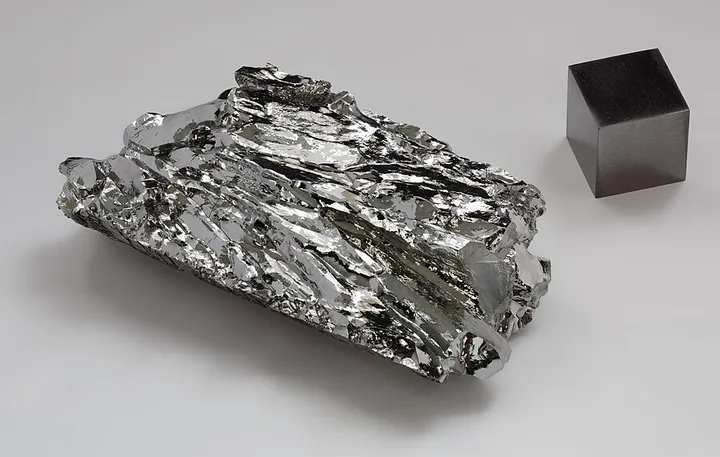
A silvery-grey metal with a very high melting point, which strengthens steel and keeps it stainless for longer. It is also vital to life: bacteria that capture nitrogen from the air need it.
1Identity card
- Atomic number
- 42protons in the nucleus
- Symbol
- Mo
- Atomic weight
- 95.95 uIUPAC standard value
- Family
- Transition metals
- Group · period · block
- 6 · 5 · d
- State at 20 °C
- solid
- Melting point
- 2,623 °C
- Boiling point
- 4,639 °C
- Density
- 10.28 g/cm³at 20 °C
- Electronegativity
- 2.16Pauling scale
- Electron configuration
- [Kr] 4d5 5s1
- Electrons per shell
- 2 · 8 · 18 · 13 · 1
- Earth’s crust
- 1.2 g per tonne
- Discovery
- 1778Carl Wilhelm Scheele; Peter Jacob Hjelm (isolated in 1781)
- Place
- Köping and Uppsala (Sweden)
2The molybdenum atom
An atom of molybdenum has 42 protons in its nucleus and, when neutral, as many electrons, spread over 5 shells.
3Discovery
Molybdenite, a soft grey mineral, was long confused with graphite and with lead ores. In 1778, in Sweden, Carl Wilhelm Scheele showed it was the sulfide of an unknown element.
His friend Peter Jacob Hjelm isolated the metal in 1781, in Uppsala, by heating the oxide with charcoal.
Want to know more about Scheele and other scientists? Visit Les inventeurs, a sister site devoted to scientists and their inventions (in French).
4Origin of the name
From the Greek molybdos, “lead”, because of the old confusion with lead ores.
5Where is it found?
Molybdenum is extracted from molybdenite (molybdenum sulfide) in China, Chile, Peru and the United States, often as a by-product of copper mines. The human body contains a few milligrams.
6Uses
- High-strength steels and stainless steels for seawater (about 80% of use).
- Catalysts that remove sulfur from fuels.
- Solid lubricant (molybdenum disulfide) for engines and gears.
- Molybdenum-99, the source of the technetium-99m used in medical imaging.
7Did you know?
Nitrogenase, the enzyme bacteria use to capture nitrogen from the air and fertilise soils, contains molybdenum.
8Isotopes
Seven natural isotopes; molybdenum-98 is the most abundant (about 24%).
Isotopes found in nature and their abundance (CIAAW data)
9Its neighbours in the table
Elements in the same column often have similar chemistry; those in the same row have the same number of electron shells.