Nickel
Nickel · Ni · 28
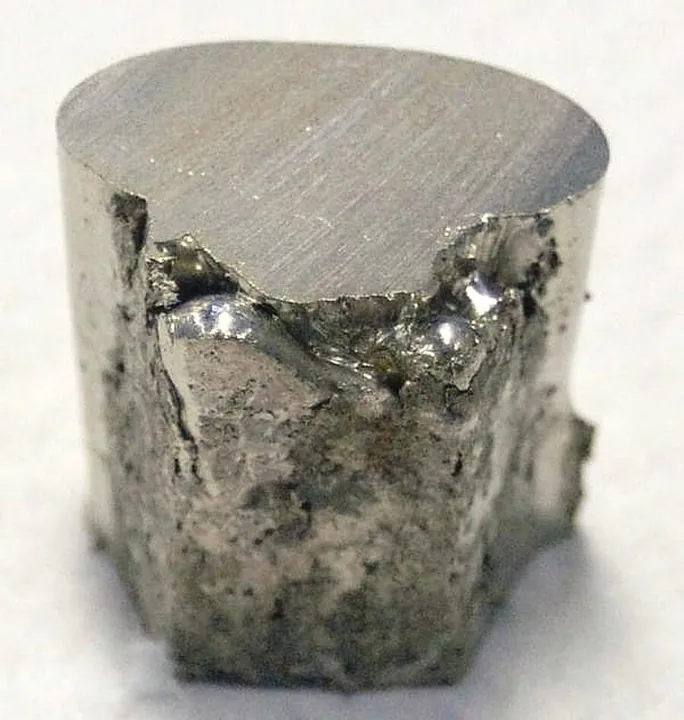
A hard, silvery-white, magnetic metal that resists corrosion very well. It goes into stainless steel, coins and batteries, and together with iron it forms the core of our planet.
1Identity card
- Atomic number
- 28protons in the nucleus
- Symbol
- Ni
- Atomic weight
- 58.693 uIUPAC standard value : 58.6934
- Family
- Transition metals
- Group · period · block
- 10 · 4 · d
- State at 20 °C
- solid
- Melting point
- 1,455 °C
- Boiling point
- 2,913 °C
- Density
- 8.908 g/cm³at 20 °C
- Electronegativity
- 1.91Pauling scale
- Electron configuration
- [Ar] 3d8 4s2
- Electrons per shell
- 2 · 8 · 16 · 2
- Earth’s crust
- 84 g per tonne
- Discovery
- 1751Axel Fredrik Cronstedt
- Place
- Stockholm (Sweden)
2The nickel atom
An atom of nickel has 28 protons in its nucleus and, when neutral, as many electrons, spread over 4 shells.
3Discovery
German miners knew a reddish ore that looked like copper ore but never yielded any copper. They called it Kupfernickel, “the devil’s copper”.
In 1751, in Stockholm, Axel Fredrik Cronstedt studied this ore, niccolite, and extracted a new white, magnetic metal from it.
4Origin of the name
From Kupfernickel, the nickname of this deceptive ore; in German, Nickel meant a mischievous goblin.
5Where is it found?
Nickel is extracted from sulfide ores (Russia, Canada) and from laterites, weathered tropical soils, in Indonesia (the leading producer), the Philippines and New Caledonia.
The Sudbury deposit in Canada lies in a huge crater dug by a meteorite impact 1.85 billion years ago.
6Uses
- Stainless steel: about two thirds of consumption.
- Rechargeable batteries (nickel–metal hydride, and the lithium-ion batteries of electric cars).
- Coins, and decorative and protective nickel plating.
- Superalloys for turbines and jet engines.
7Did you know?
In the United States the 5-cent coin is called a “nickel”, although it is only a quarter nickel.
Iron meteorites are made of an iron–nickel alloy, much like the Earth’s core.
Safety: Prolonged contact with nickel causes a skin allergy in some people (jewellery, belt buckles).
8Isotopes
Five stable isotopes; nickel-58 (about 68%) and nickel-60 (about 26%) are the most abundant.
Isotopes found in nature and their abundance (CIAAW data)
9Its neighbours in the table
Elements in the same column often have similar chemistry; those in the same row have the same number of electron shells.