Copper
Cuivre · Cu · 29
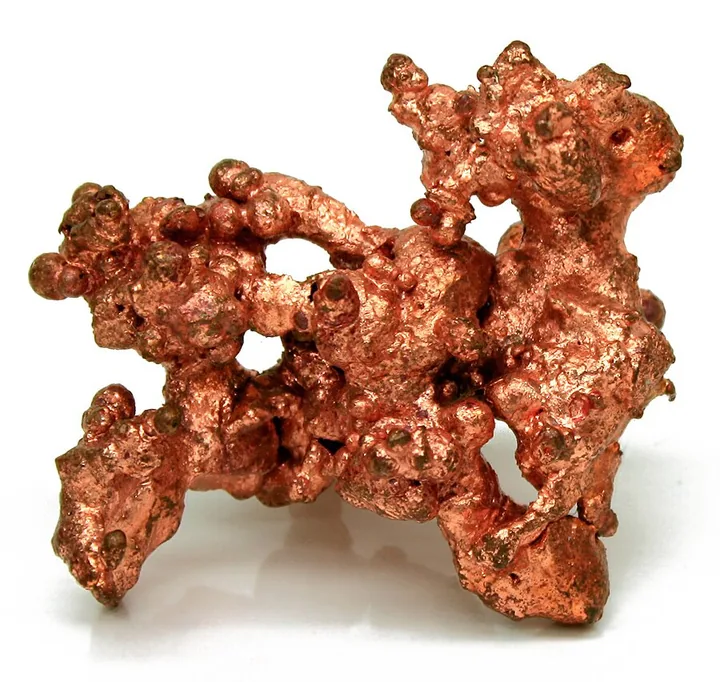
A soft, reddish-orange metal that is easy to work, the first metal humanity ever shaped. An excellent conductor, it carries electricity in almost every wire in the world.
1Identity card
- Atomic number
- 29protons in the nucleus
- Symbol
- Cu
- Atomic weight
- 63.546 uIUPAC standard value
- Family
- Transition metals
- Group · period · block
- 11 · 4 · d
- State at 20 °C
- solid
- Melting point
- 1,084.62 °C
- Boiling point
- 2,562 °C
- Density
- 8.96 g/cm³at 20 °C
- Electronegativity
- 1.9Pauling scale
- Electron configuration
- [Ar] 3d10 4s1
- Electrons per shell
- 2 · 8 · 18 · 1
- Earth’s crust
- 60 g per tonne
- Discovery
- Known since prehistoric times
2The copper atom
An atom of copper has 29 protons in its nucleus and, when neutral, as many electrons, spread over 4 shells.
3Discovery
Copper sometimes occurs in native form, as nuggets; it was probably the first metal ever used. A copper pendant found in northern Iraq dates from around 9000 BCE. Around 5000 BCE people learned to extract it from its ores by heating them.
Mixed with tin it gives bronze, so important that it named an era, the Bronze Age. Ötzi, the iceman who died in the Alps more than 5,000 years ago, carried an axe of almost pure copper.
4Origin of the name
From the Latin cuprum, short for aes Cyprium, “metal of Cyprus”, an island famous for its mines in antiquity.
5Where is it found?
Copper is mined mainly from chalcopyrite and other sulfides, in huge open-pit mines in Chile (the leading producer), Peru and the Democratic Republic of the Congo.
The human body contains about 100 milligrams; it is essential to many enzymes.
6Uses
- Electric wires and cables, motors, transformers: its main use.
- Plumbing pipes, heating and air conditioning.
- Alloys: brass (with zinc), bronze (with tin), cupronickel for coins.
- Roofing and antimicrobial surfaces in hospitals.
7Did you know?
The Statue of Liberty in New York was copper-coloured when it was unveiled in 1886; it took on its green patina in about thirty years.
Octopuses, crabs and snails have blue blood: it carries oxygen using a protein that contains copper.
8Isotopes
Two stable isotopes, copper-63 (about 69%) and copper-65 (about 31%).
Isotopes found in nature and their abundance (CIAAW data)
9Emission spectrum
As a gas or vapour, when heated or crossed by an electric current, copper atoms give off light at a few very precise wavelengths: these are their lines, a true barcode of the element. Several elements were discovered by observing such lines in a spectroscope.
For listening, each light frequency is divided by 2⁴⁰: the light is transposed down forty octaves, which keeps the exact ratios between the lines. Point to or tap a line to hear it alone.
10Its neighbours in the table
Elements in the same column often have similar chemistry; those in the same row have the same number of electron shells.