Gallium
Gallium · Ga · 31
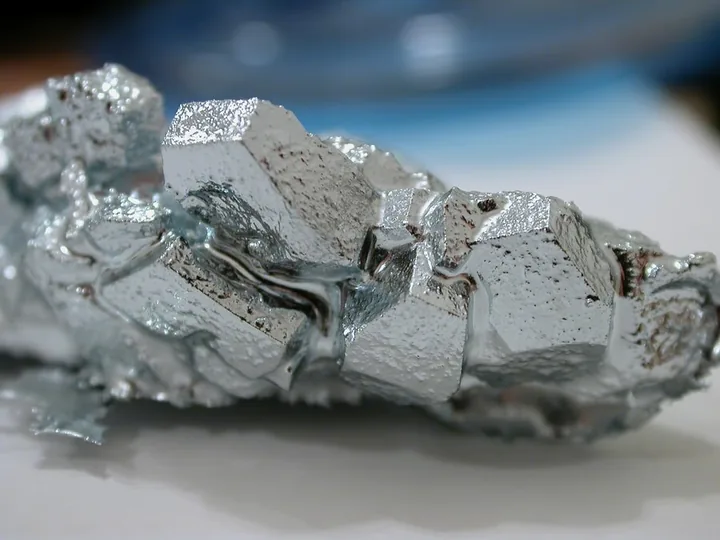
A silvery metal that melts in your hand, below 30 °C, yet does not boil until above 2,000 °C. Combined with arsenic or nitrogen, it makes LEDs shine and phones work.
1Identity card
- Atomic number
- 31protons in the nucleus
- Symbol
- Ga
- Atomic weight
- 69.723 uIUPAC standard value
- Family
- Post-transition metals
- Group · period · block
- 13 · 4 · p
- State at 20 °C
- solid
- Melting point
- 29.76 °C
- Boiling point
- 2,229 °C
- Density
- 5.91 g/cm³at 20 °C
- Electronegativity
- 1.81Pauling scale
- Electron configuration
- [Ar] 3d10 4s2 4p1
- Electrons per shell
- 2 · 8 · 18 · 3
- Earth’s crust
- 19 g per tonne
- Discovery
- 1875Paul-Émile Lecoq de Boisbaudran
- Place
- Paris (France)
2The gallium atom
An atom of gallium has 31 protons in its nucleus and, when neutral, as many electrons, spread over 4 shells.
3Discovery
In 1871 Dmitri Mendeleev predicted the existence of an “eka-aluminium” and described its properties. Four years later, in Paris, Paul-Émile Lecoq de Boisbaudran examined a zinc ore from the Pyrenees with a spectroscope and spotted two unknown violet lines.
He isolated the metal the same year. Mendeleev wrote to him that the measured density (4.7) was wrong and should be close to 5.9: Lecoq repeated the measurement with a purer sample and found 5.9. The periodic table had just won a dazzling proof.
Want to know more about Mendeleev and other scientists? Visit Les inventeurs, a sister site devoted to scientists and their inventions (in French).
4Origin of the name
From Gallia, the Latin name of France. It was claimed that Lecoq also had himself in mind (gallus means “rooster”, le coq in French), which he always denied.
5Where is it found?
Gallium has no ore of its own: it is recovered in small quantities when processing bauxite (for aluminium) and zinc ores. China produces almost all of the world’s supply.
6Uses
- Semiconductors: gallium arsenide and gallium nitride in LEDs, lasers, phone radio chips and fast chargers.
- Very high-efficiency solar cells for satellites.
- Alloys that are liquid at room temperature, replacing mercury in some thermometers.
- Gallium-67 and gallium-68 for medical imaging.
7Did you know?
A gallium spoon melts in a cup of hot tea: an old chemists’ prank.
Like water, gallium takes up more room when it freezes: it is not kept in a full glass bottle, which could crack.
Blue gallium-nitride LEDs, which made white LED lighting possible, earned three Japanese researchers the 2014 Nobel Prize in Physics.
8Isotopes
Two stable isotopes, gallium-69 (about 60%) and gallium-71 (about 40%).
Isotopes found in nature and their abundance (CIAAW data)
9Its neighbours in the table
Elements in the same column often have similar chemistry; those in the same row have the same number of electron shells.