Tin
Étain · Sn · 50
A soft, silvery-white metal that melts easily and has been known for more than 5,000 years. Alloyed with copper it gave bronze; today it solders the components of all our electronic devices.
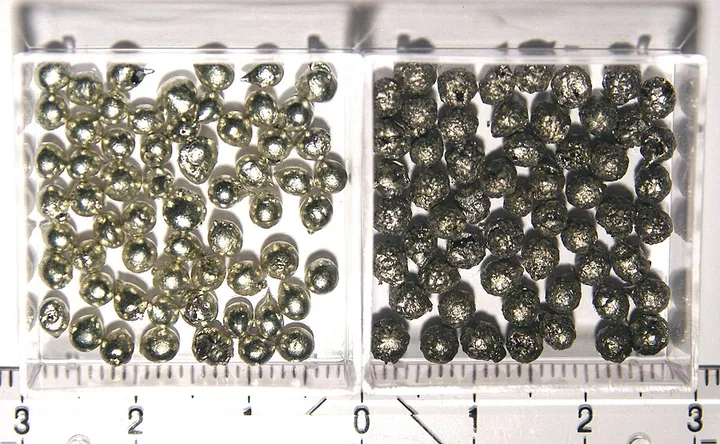
1Identity card
- Atomic number
- 50protons in the nucleus
- Symbol
- Sn
- Atomic weight
- 118.71 uIUPAC standard value
- Family
- Post-transition metals
- Group · period · block
- 14 · 5 · p
- State at 20 °C
- solid
- Melting point
- 231.93 °C
- Boiling point
- 2,602 °C
- Density
- 7.287 g/cm³white tin
- Electronegativity
- 1.96Pauling scale
- Electron configuration
- [Kr] 4d10 5s2 5p2
- Electrons per shell
- 2 · 8 · 18 · 18 · 4
- Earth’s crust
- 2.3 g per tonne
- Discovery
- Known since antiquity
2The tin atom
An atom of tin has 50 protons in its nucleus and, when neutral, as many electrons, spread over 5 shells.
3Discovery
Tin is rarely found native, but it is easily extracted from cassiterite. From around 3500 BCE, in the Near East, it was added to copper to make bronze, a much harder metal: the Bronze Age had begun.
The tin trade linked distant regions very early: the mines of Cornwall and Brittany supplied the ancient Mediterranean.
4Origin of the name
The English word is Germanic; the symbol Sn comes from the Latin stannum.
5Where is it found?
The main ore is cassiterite (tin oxide), mined mainly in China, Indonesia, Myanmar and Peru.
6Uses
- Electronics solder: about half of all tin produced.
- Tinplate: tin-coated steel for food cans.
- Alloys: bronze, pewter, organ-pipe metal.
- Making flat glass: molten glass is floated on a bath of liquid tin.
7Did you know?
When a bar of tin is bent, it makes a faint crackling sound, the “tin cry”, caused by its crystals rubbing together.
Below 13 °C white tin can slowly turn into a grey powder: “tin pest”. Legend has it, without proof, that it made the buttons fall off the uniforms of Napoleon’s army in Russia.
8Isotopes
Ten stable isotopes: the record among all elements. Tin-120 is the most abundant (about 33%).
Isotopes found in nature and their abundance (CIAAW data)
9Its neighbours in the table
Elements in the same column often have similar chemistry; those in the same row have the same number of electron shells.