Bismuth
Bismuth · Bi · 83
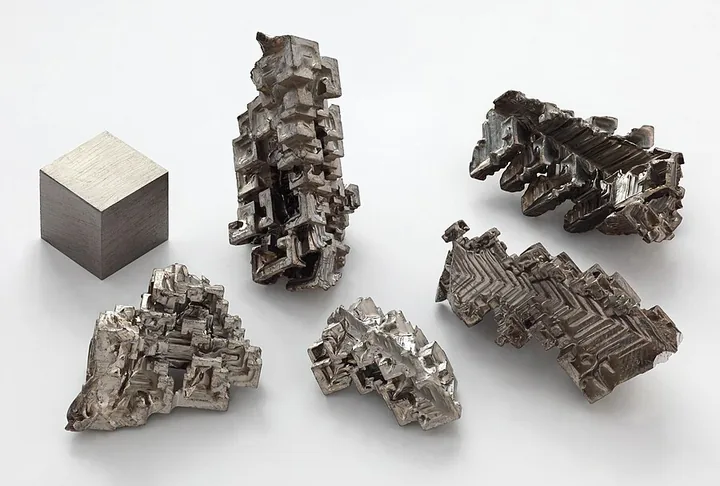
A heavy, brittle, pinkish-white metal that forms spectacular stair-step crystals with rainbow reflections. Low in toxicity, it replaces lead in many uses and soothes stomach upsets.
1Identity card
- Atomic number
- 83protons in the nucleus
- Symbol
- Bi
- Atomic weight
- 208.98 uIUPAC standard value : 208.9804
- Family
- Post-transition metals
- Group · period · block
- 15 · 6 · p
- State at 20 °C
- solid
- Melting point
- 271.4 °C
- Boiling point
- 1,564 °C
- Density
- 9.78 g/cm³at 20 °C
- Electronegativity
- 2.02Pauling scale
- Electron configuration
- [Xe] 4f14 5d10 6s2 6p3
- Electrons per shell
- 2 · 8 · 18 · 32 · 18 · 5
- Earth’s crust
- 8.5 mg per tonne
- Discovery
- 1753Claude François Geoffroy (metal known since the 15th century)
- Place
- Paris (France)
2The bismuth atom
An atom of bismuth has 83 protons in its nucleus and, when neutral, as many electrons, spread over 6 shells.
3Discovery
Bismuth was known to German miners since at least the 15th century, but it was often confused with tin and lead. The German Georgius Agricola described it in 1546 under the Latin name bisemutum.
In 1753, in Paris, the chemist Claude François Geoffroy showed that it was a distinct metal.
4Origin of the name
From the German Wismut, of uncertain origin, perhaps “white mass”; Agricola derived the Latin bisemutum from it.
5Where is it found?
Bismuth is mainly a by-product of refining lead, copper and tungsten, mostly in China.
6Uses
- Medicines for stomach upsets and ulcers.
- Pearly pigments in cosmetics (bismuth oxychloride).
- Lead-free solders, lead-free shot and brass for taps.
- Very low-melting alloys that trigger fire sprinklers.
7Did you know?
Long thought to be stable, bismuth-209 was shown to be radioactive in 2003 by a team in Orsay, France: its half-life, about 2 × 10¹⁹ years, is more than a billion times the age of the Universe.
It is the most diamagnetic metal: it is slightly repelled by magnets, so much so that a strong magnet can make a small plate of bismuth levitate.
8Isotopes
A single natural isotope, bismuth-209, so weakly radioactive that it is practically stable.
Isotopes found in nature and their abundance (CIAAW data)
9Its neighbours in the table
Elements in the same column often have similar chemistry; those in the same row have the same number of electron shells.