Thallium
Thallium · Tl · 81
A soft, bluish-grey and very toxic metal. Discovered thanks to a brilliant green spectral line, today it is used in small amounts in electronics and medical imaging.
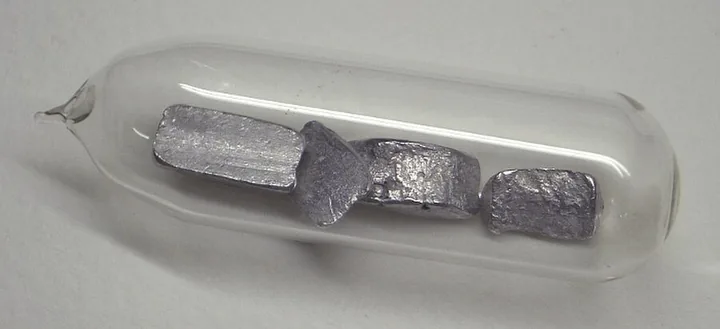
1Identity card
- Atomic number
- 81protons in the nucleus
- Symbol
- Tl
- Atomic weight
- 204.38 uIUPAC standard value
- Family
- Post-transition metals
- Group · period · block
- 13 · 6 · p
- State at 20 °C
- solid
- Melting point
- 304 °C
- Boiling point
- 1,473 °C
- Density
- 11.85 g/cm³at 20 °C
- Electronegativity
- 1.62Pauling scale
- Electron configuration
- [Xe] 4f14 5d10 6s2 6p1
- Electrons per shell
- 2 · 8 · 18 · 32 · 18 · 3
- Earth’s crust
- 850 mg per tonne
- Discovery
- 1861William Crookes
- Place
- London (England)
2The thallium atom
An atom of thallium has 81 protons in its nucleus and, when neutral, as many electrons, spread over 6 shells.
3Discovery
In 1861, in London, William Crookes examined the residues of a sulfuric acid works with a spectroscope and saw an intense green line never seen before. He announced a new element.
The Frenchman Claude-Auguste Lamy, in Lille, also discovered it independently and cast the first ingot in 1862. A long priority dispute set the two scientists against each other.
4Origin of the name
From the Greek thallos, “green shoot”, because of the colour of its spectral line.
5Where is it found?
Rare, thallium is recovered when processing zinc, lead and copper ores.
6Uses
- Electronics and infrared optics (in very small amounts).
- Thallium-201 for some heart scans.
- Formerly rat poison and hair-removal cream, now banned.
7Did you know?
In a 1961 detective novel, Agatha Christie described the symptoms of thallium poisoning so precisely that readers, including a nurse, later recognised real cases.
Safety: Very toxic, even at low doses.
8Isotopes
Two stable isotopes, thallium-205 (about 70%) and thallium-203 (about 30%).
Isotopes found in nature and their abundance (CIAAW data)
9Emission spectrum
As a gas or vapour, when heated or crossed by an electric current, thallium atoms give off light at a few very precise wavelengths: these are their lines, a true barcode of the element. Several elements were discovered by observing such lines in a spectroscope.
For listening, each light frequency is divided by 2⁴⁰: the light is transposed down forty octaves, which keeps the exact ratios between the lines. Point to or tap a line to hear it alone.
10Its neighbours in the table
Elements in the same column often have similar chemistry; those in the same row have the same number of electron shells.