Silicon
Silicium · Si · 14
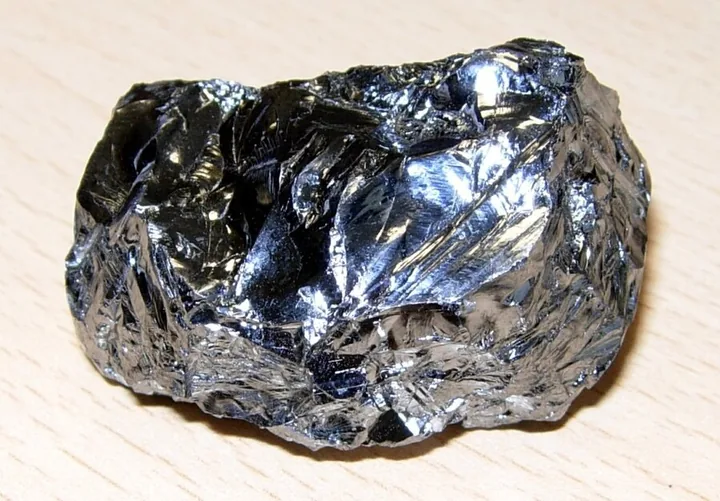
A shiny blue-grey metalloid, the second most abundant element in the Earth’s crust. Bound to oxygen it forms sand and most rocks; ultra-pure, it is the heart of electronics and solar panels.
1Identity card
- Atomic number
- 14protons in the nucleus
- Symbol
- Si
- Atomic weight
- 28.085 uIUPAC standard value
- Family
- Metalloids
- Group · period · block
- 14 · 3 · p
- State at 20 °C
- solid
- Melting point
- 1,414 °C
- Boiling point
- 3,265 °C
- Density
- 2.33 g/cm³at 20 °C
- Electronegativity
- 1.9Pauling scale
- Electron configuration
- [Ne] 3s2 3p2
- Electrons per shell
- 2 · 8 · 4
- Earth’s crust
- 28.2 %
- Discovery
- 1824Jöns Jacob Berzelius
- Place
- Stockholm (Sweden)
2The silicon atom
An atom of silicon has 14 protons in its nucleus and, when neutral, as many electrons, spread over 3 shells.
3Discovery
Silica (quartz, sand, flint) has always been known, and Lavoisier already suspected that it contained an unknown element. Joseph Louis Gay-Lussac and Louis Jacques Thénard probably obtained a little impure silicon in 1811.
It was Jöns Jacob Berzelius, in Stockholm in 1824, who prepared silicon pure enough to describe, by heating potassium fluorosilicate with potassium. Henri Sainte-Claire Deville produced the first crystalline silicon in 1854.
Want to know more about Lavoisier, Berzelius, Gay-Lussac and other scientists? Visit Les inventeurs, a sister site devoted to scientists and their inventions (in French).
4Origin of the name
From the Latin silex, silicis, “flint”, a rock made of silica. The English ending -on, chosen by Thomas Thomson in 1817, echoes boron and carbon.
5Where is it found?
Silicon makes up about 28% of the mass of the Earth’s crust, second only to oxygen. It never occurs pure: it is found in quartz, sand, clays, feldspars and micas, which form most rocks.
Some living things use it, such as diatoms, microscopic algae with silica shells, and horsetail plants.
6Uses
7Did you know?
Silicon Valley in California owes its nickname to the many silicon chip companies that settled there from the 1960s.
For electronics, silicon is purified to less than one foreign atom per billion.
A perfect sphere of almost pure silicon-28 was used to measure the Avogadro constant with record accuracy, ahead of the redefinition of the kilogram in 2019.
8Isotopes
Three stable isotopes, silicon-28 (about 92%), silicon-29 (4.7%) and silicon-30 (3.1%).
Isotopes found in nature and their abundance (CIAAW data)
9Its neighbours in the table
Elements in the same column often have similar chemistry; those in the same row have the same number of electron shells.